
Built to Endure: Eight Years of Living Infrastructure in Chicago
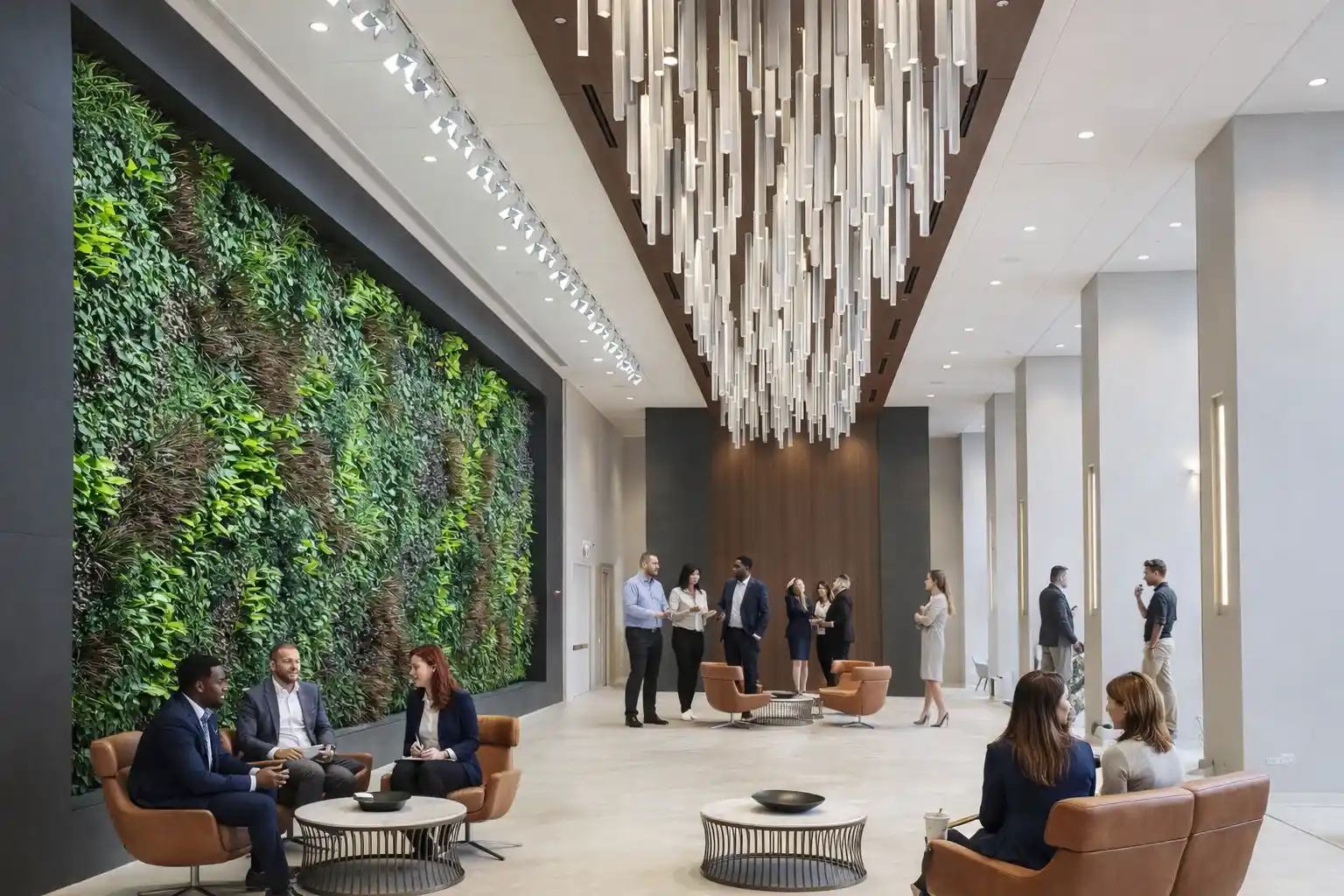
On the 44th floor of Tishman Speyer’s Franklin building in Chicago, nature rises to meet modern architecture.
Installed in 2018, this 700-square-foot, floor-to-ceiling living wall anchors the building’s lounge space. It transforms a vertical interior surface into a living, breathing system that supports wellness, creativity, and sustainability at architectural scale. Designed in collaboration with Garnett Architects, the project reflects a shared ambition: to integrate biophilic design as high-performance building infrastructure.
More than eight years later, the wall continues to thrive—standing as proof that longevity is the true measure of sustainable design.
A Living Wall as Art, Infrastructure, and Experience
Comprising 4,620 living plants across eight distinct species, the wall features a tartan-inspired pattern with layered tones of green and purple. The result is a striking composition that bridges modern art and living architecture. It is an immersive focal point that reshapes how the space feels, functions, and performs.
Located within a communal lounge, the wall was conceived not just to be seen, but to be experienced. It draws people together, softens the interior environment, and introduces organic movement and texture at a dramatic vertical scale.
Wellness, Backed by Performance Data
From the earliest feasibility and design stages through commissioning and installation, SageGreenLife® worked closely with Tishman Speyer to ensure the wall delivered outcomes, not just visual impact.
The performance science behind living walls is well established. Peer-reviewed research demonstrates:
- Air quality: Indoor active living walls, when properly designed, can deliver air purifying performance comparable to a HVAC system — continuously removing particulate matter, CO₂, and volatile organic compounds (Tang, 2023)
- Productivity: Employees in offices enriched with plants demonstrated 15% higher productivity and significantly higher concentration and workplace satisfaction across three field experiments in the UK and Netherlands (Nieuwenhuis et al., 2014)
- Absenteeism: Employees with direct views of nature took on average 11 fewer sick hours per year than those without — with 10% of all workplace absences attributable to architectural environments that failed to connect occupants with nature (Elzeyadi, 2011)
These outcomes align directly with Tishman Speyer’s sustainability and tenant-wellbeing objectives — reinforcing that healthier buildings support long-term value, satisfaction, and performance.
Designed for Longevity, Built to Perform Over Time
What distinguishes the Franklin living wall is not only how it performed at launch—but how it continues to perform years later.
More than eight years after installation, the wall remains vibrant and healthy. This durability reflects intentional system design, appropriate plant selection, and a robust hydroponic infrastructure engineered for long-term lifecycle performance.
Living architecture is often judged in its first year. But real sustainability is proven over time.
At The Franklin, the living wall was conceived as permanent green infrastructure, designed to age forward. Its continued vitality demonstrates that when living systems are engineered correctly, they become enduring assets rather than recurring maintenance challenges.
Intelligent Systems, Then and Now
While the Franklin installation predates today’s cloud-connected SmartWall® platform, it embodies the same foundational principles that now define SageGreenLife®’s intelligent living infrastructure:
- Lifecycle-first design, prioritizing durability and operational stability
- Performance accountability, where systems are expected to deliver year after year
- Infrastructure-grade thinking, treating living walls as assets—not décor
Today, SageGreenLife®’s SmartWall® platform extends this approach with data visibility, system intelligence, and portfolio-level insights. Specifically, helping owners and operators manage living architecture with the same rigor applied to mechanical and digital building systems.
The Franklin living wall stands as proof of concept: when living walls are designed properly, they scale not only across buildings—but across time.
Elevating the Workplace—Literally
Forty-four floors above Chicago, the Franklin living wall reconnects occupants with nature—offering calm, inspiration, and connection within a dense urban environment. It demonstrates that biophilic design can deliver sustained human and environmental benefits without compromising operational efficiency.
By selecting an advanced hydroponic system with minimal water use, building impacts were carefully minimized—showing how living walls can support sustainability goals while integrating seamlessly into high-performance commercial environments.
This same philosophy of embedding living walls at the heart of the workplace is evident at Waste Management’s LEED Platinum headquarters in Houston. This nine-story SageGreenLife living wall anchors the building’s central staircase—earning the 2025 AIA National Interior Architecture Award.
Longevity Is the New Sustainability
A living wall that continues to thrive after eight years represents more than good design—it represents:
- Reduced lifecycle waste and replacement costs
- Lower long-term environmental impact
- Consistent occupant experience and tenant satisfaction
- A durable ESG asset aligned with institutional ownership horizons
At SageGreenLife®, we believe buildings should do more than shelter. They should perform, inspire, and improve quality of life—over decades, not design cycles.
The Franklin living wall remains a living landmark. It quietly demonstrates that when nature is paired with intelligent design, green infrastructure can endure, adapt, and deliver measurable value over time.
As cities across the Middle East pursue similar ambitions under Vision 2030 and Net Zero 2050, the Franklin project offers a proven precedent. It demonstrates that living walls engineered for longevity can also serve as scalable climate infrastructure for cooling cities facing extreme heat.
Considering a living wall for your next project?
SageGreenLife® SmartWalls® are engineered for the same longevity demonstrated at The Franklin — with the intelligence layer to measure, report, and prove performance over time.
See the Benefits · Contact Us · Explore SmartWalls®
Let’s build living intelligence—where nature endures, and buildings perform.
